You have questions and we have answers.
Non-contact Measurement for Level, Distance, and Presence Detection
Ultrasonic sensors provide non-contact detection and distance measurement using reflected sound. Ultrasonic sensors are wide ranging and versatile, but each sensor comes with certain constraints. Selecting the right sensor requires evaluating sensing range, target geometry, beam pattern, environment, output, response time, and mounting conditions.
Migatron manufactures ultrasonic sensors for industrial automation, level measurement, positioning, and hazardous area applications.
Is Ultrasonic Sensing Right for Your Application?
Ultrasonic sensing is a good option when equipment needs to detect an object or measure distance without physical contact.
Common applications include:
- Distance measurement
- Object detection
- Liquid or bulk material level
- Machine positioning
- Roll diameter
- Transparent or reflective targets
Because detection is based on sound rather than light, target color and transparency usually have little effect.
Applications involving tiny targets, steep angles, sound absorbing materials or nearby obstructions may require additional testing.
How Does an Ultrasonic Sensor Measure Distance?
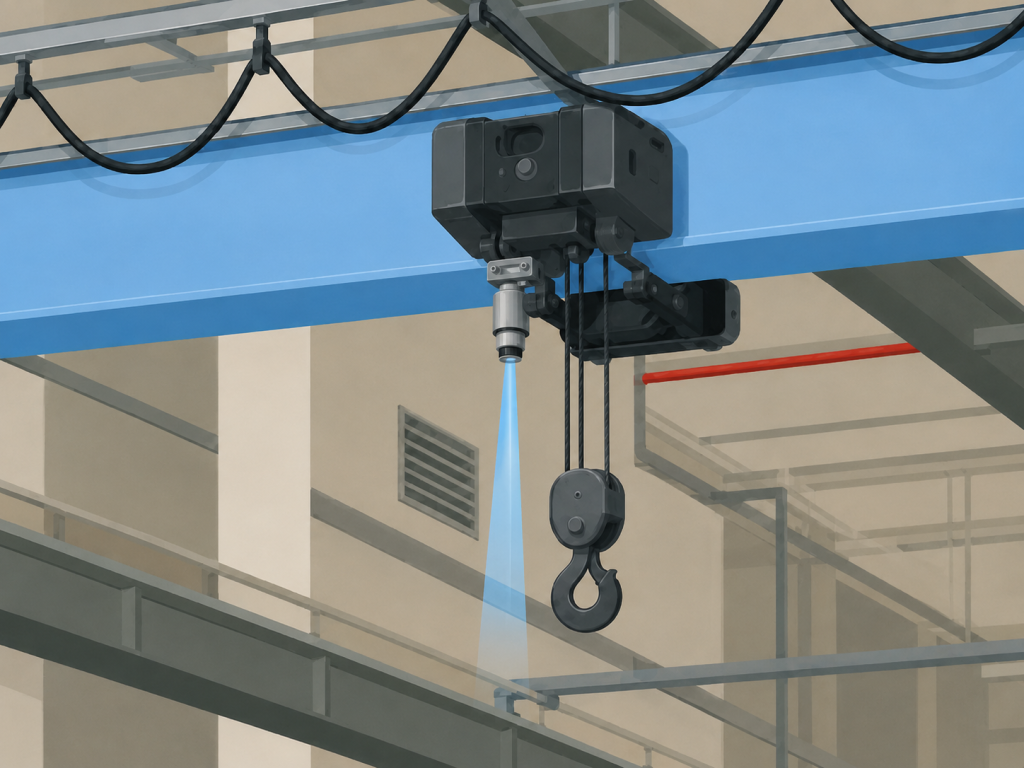
An ultrasonic sensor measures the time of flight of a sound pulse.
- The sensor transmits an ultrasonic pulse.
- Sound travels toward the target.
- The target reflects sound back.
- The sensor receives the echo.
- Travel time is converted into distance.
Ā
What Should Engineers Evaluate Before Selecting an Ultrasonic Sensor?
Sensor selection should be based on the complete application, not maximum sensing range alone.
Sensing Range and Blind Zone
Define the minimum and maximum target distances.
Every ultrasonic sensor has a minimum sensing distance, or blind zone, directly in front of the sensor where reliable measurement is not possible.
The target must remain outside this area during normal operation.
Read our Blog Post: Planning Ultrasonic Sensor Installations
Beam Pattern
Ultrasonic sensors transmit sound through a sensing field rather than a single narrow line.
Objects inside the beam can create unwanted echoes, including:
- Tank walls
- Pipes
- Machine frames
- Brackets
- Structural supports
Review the beam pattern before finalizing the sensor mounting location.
Target Size and Angle
Large, flat targets positioned approximately perpendicular to the sensor generally provide the strongest return.
Angled smooth surfaces can reflect sound away from the sensor.
Evaluate:
- Target size
- Shape
- Surface
- Angle
- Movement
A variety of low cost mounting hardware is often used to ensure proper target alignment. Our engineering team can assist with the selection and sourcing of mounting hardware.
Can Multiple Ultrasonic Sensors Interfere?
Yes. Sensors mounted near one another can experience cross-talk when one sensor receives another sensor’s transmission.
Cross-talk can be reduced through spacing, orientation, transmission timing, or synchronization.
Some Migatron sensors include Sync/Tx functionality for multi-sensor installations.
This issue is easily avoided with the right planning.
When Should You Choose Ultrasonic?
Requirement | Ultrasonic | Photoelectric | Capacitive | Inductive |
Non-contact detection | Yes | Yes | Yes | Yes |
Distance measurement | Yes | Model dependent | Limited | No |
Liquid level | Yes | Application dependent | Application dependent | No |
Transparent targets | Yes | Sensor dependent | Possible | No |
Sensitive to target color | Yes | Can matter | Low | Low |
Very small targets | Application dependent | Strong | Application dependent | Strong for metal |
No sensing technology is best for every application. Target characteristics, environment, measurement requirements, and mounting geometry should determine the choice.Ā
Read our Blog Post: Design Considerations for Tank Level Measurement
Which Migatron Sensor Fits Your Application?
Application Requirement | Migatron Sensor Option |
General analog distance measurement sensor | |
Compact 4-40 in. analog and pulse-width measurement sensor | |
Short range proximity detection sensor | |
Wide beam bulk material detection sensor | |
Long range 4-20 mA distance measurement sensor | |
High accuracy short range measurement sensor | |
Intrinsically safe analog voltage sensor | |
Intrinsically safe 4-20 mA sensor | |
Automation sensor with specialized parametersĀ |
Do You Need an Intrinsically Safe Ultrasonic Sensor?
Applications involving combustible gases, vapors, dusts, or mines susceptible to firedamp may require approvals for use in hazardous locations and explosive atmospheres.
Migatron offers intrinsically safe ultrasonic sensors for selected Class/Division and Zone classifications.
The RPS-409A-IS2 family includes ATEX, IECEx, ANZEx, and C-UL-US approvals. The RPS-429A-IS family provides intrinsically safe 4-20 mA and analog voltage options.
Approvals vary by model. Installations must follow the applicable control drawing, entity parameters, safety barrier requirements, and local regulations.
Contact our engineering team to review specs and documentation.Ā
Ā
Are You Designing Ultrasonic Sensing Into New Equipment?
Choosing the right sensor requires more than matching a sensing range to a datasheet.
Send Migatron your application requirements and our engineering team can help determine whether ultrasonic sensing is appropriate.
Helpful information includes:
- Application
- Target
- Minimum and maximum distance
- Required output
- Operating environment
- Mounting location
- Estimated quantity
Ā
Related Resources
Learn more about ultrasonic sensor applications, intrinsically safe ultrasonic sensors, and technical resources for tank level measurement, distance sensing, and industrial process control.

.