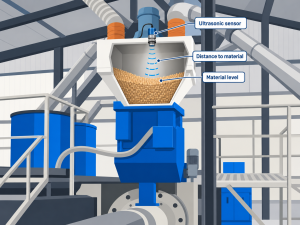
Design Considerations for Tank Level Measurement
Getting Reliable Performance from Ultrasonic Sensors Ultrasonic sensors are widely used for tank level measurement because they provide non-contact, continuous monitoring without being affected by
Home » Blog
This resource center brings together technical articles, application guides, and design insights for ultrasonic sensors. Engineers and OEMs use these articles to evaluate non-contact sensing solutions, understand performance in industrial environments, and solve common challenges in level measurement, positioning, and hazardous area applications.
Topics include sensor selection, tank level measurement, intrinsically safe design, and installation best practices across a wide range of industries.

Getting Reliable Performance from Ultrasonic Sensors Ultrasonic sensors are widely used for tank level measurement because they provide non-contact, continuous monitoring without being affected by

Maintaining a consistent feed rate is essential for efficient crusher operation. Crushers perform best when material enters the chamber at a steady, controlled rate. When

The Challenge: Maintaining Flow in High-Speed Food Production Food processing operations depend on consistent, uninterrupted product flow. High-speed conveyors move large volumes of material from

Efficient material handling is essential in mining operations. Ore bins and hoppers act as critical buffer points between crushing, conveying, and processing stages. Maintaining proper

In packaging and logistics facilities, conveyor systems are critical to maintaining throughput and efficiency. When these systems drift out of alignment, even slightly, the result

Conveyor systems are the backbone of most mining operations. They move crushed ore, aggregates, and bulk materials continuously between crushers, storage bins, and processing equipment.
Practical guidance for engineers designing with ultrasonic sensors