
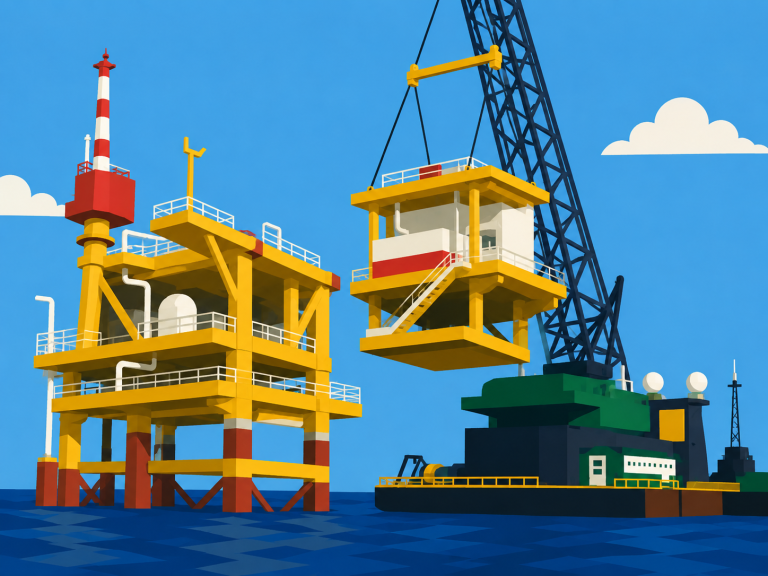
Crane equipment on an offshore oil rig often operates in tight, harsh, and hazardous environments where reliable short-range position detection is needed for safe, repeatable machine operation. When detecting a crane yoke, arm, or related structure, the sensing method should work without physical contact, reduce mechanical wear, and integrate cleanly with existing controls.
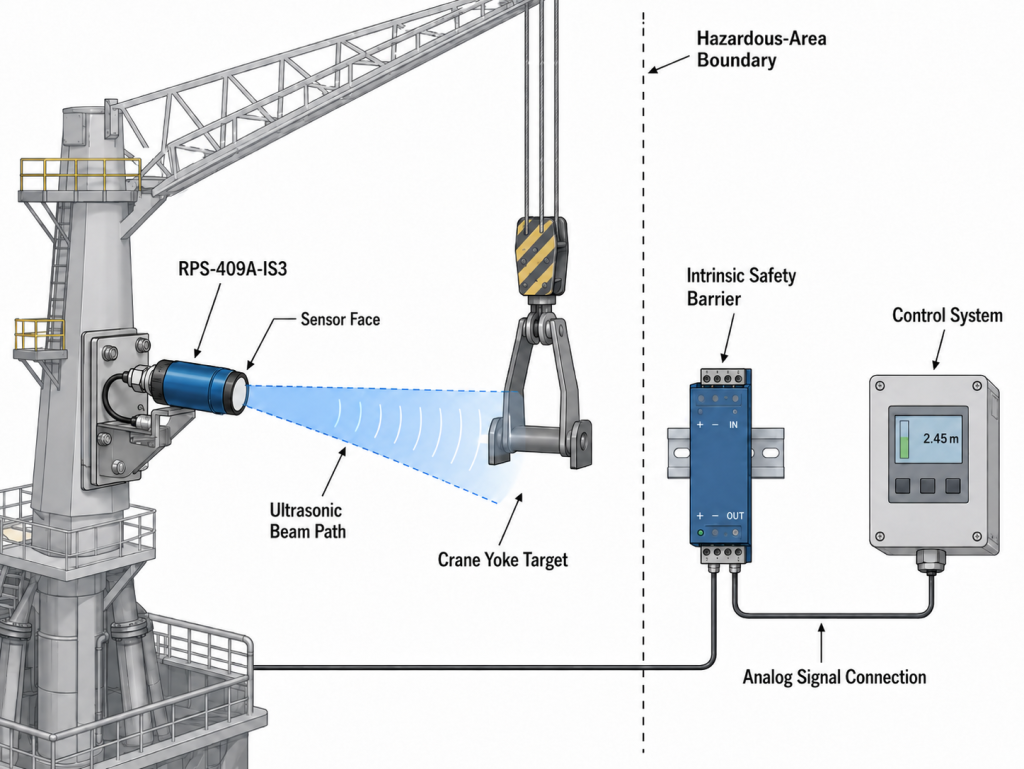
For crane yoke detection in hazardous offshore oil and gas areas, Migatron’s RPS-409A-IS3 Intrinsically Safe Ultrasonic Sensor may be a practical fit when the target is within the sensor’s operating range and a clear acoustic path is available. The RPS-409A-IS3 provides non-contact ultrasonic distance detection with a 0 to 10 VDC analog output, making it suitable for short-range position feedback applications where cULus compliant equipment is required.
Quick Answer Box
| Question | Answer |
| What problem does this solve? | Non-contact detection or distance monitoring of a crane yoke or crane-related structure in a hazardous offshore environment. |
| Best fit for ultrasonic sensing? | Yes, if the crane yoke presents a detectable surface within the sensor range and the beam path is clear. |
| Typical measurement needed | Short-range detection or distance feedback, approximately 4 to 216 inches. |
| Output type | Analog voltage output, typically 0 to 10 VDC depending on selected model and range. |
| Suggested Migatron sensor | RPS-409A-40-IS3 Intrinsically Safe Ultrasonic Sensor. |
| When to contact engineering | When confirming hazardous area approval, barrier requirements, target geometry, mounting angle, cable requirements, or control input compatibility. |
Application Overview
Offshore oil rig equipment can include cranes, lifting systems, handling equipment, and mechanical structures that require position confirmation or distance feedback during operation. In this application, the target is a crane yoke. The sensing goal is to detect the crane yoke or monitor its position within a short sensing window.
A non-contact ultrasonic sensor can help because it does not need to physically touch the crane structure. This can reduce wear compared with mechanical limit switches and can make installation easier when the sensor can be mounted near the target with a clear view. For applications where the target may move repeatedly, non-contact detection can also help avoid problems caused by vibration, impact, or mechanical misalignment.
Performance depends on several factors. The crane yoke surface should be large enough and oriented well enough to reflect the ultrasonic signal back to the sensor. The target should pass through the usable detection zone, and the sensor should be mounted so the sound beam is not blocked by nearby brackets, guards, cables, or structural members. Offshore conditions also require review of temperature, moisture, corrosion exposure, electrical installation practices, and hazardous area approval requirements.
Because this application is in a hazardous area on an offshore oil rig, the approval requirement matters as much as the sensing range. The RPS-409A-IS3 is designed for hazardous gas or dust environments classified as Class I, II, or III when installed with approved intrinsic safety barriers. For this reason, the installation should be reviewed against the sensor documentation, control drawing, and site requirements.
How Ultrasonic Sensors Work in This Application
An ultrasonic sensor sends out high-frequency sound pulses and measures the time it takes for the echo to return from the target. The sensor then converts that time-of-flight measurement into a distance related output.
For crane yoke detection, the sensor would typically be mounted so its face points toward the expected path or position of the yoke. When the yoke enters the sensing area, the ultrasonic pulse reflects off the target surface and returns to the sensor. The analog voltage output can then provide distance feedback to a PLC, controller, display, or other analog input device.
In a 4 to 216 inch range application, the key is to position the sensor so the yoke remains outside the blind zone and within the active sensing range. The sensor should also be aimed so the echo returns directly to the sensor face.
Will Ultrasonic Work Here?
Ultrasonic sensing is usually a good fit when:
- The crane yoke target surface is within the selected sensor range.
- The sensor can be mounted with a clear beam path.
- The target movement is repeatable enough for consistent detection.
Ultrasonic sensing may need review when:
- The target surface is very narrow, angled, curved, or irregular.
- The sensor face cannot be aligned with the target.
- Heavy spray, buildup, condensation, or debris could interfere with the sensor face.
Key Questions
| Question | Why It Matters |
| What is the required sensing distance from the sensor face to the crane yoke? | Confirms whether the target is within the selected 4 to 216 inch sensing range (range varies by model). |
| Is the sensor used for presence detection, position feedback, or process interlock support? | Defines whether analog feedback is the right output type. |
| What hazardous area classification applies to the installation? | Confirms whether the C-UL-US intrinsically safe model and approved barrier are suitable. |
| Where can the sensor be mounted? | Mounting location determines beam angle, target visibility, and installation practicality. |
| Are there obstructions between the sensor and the yoke? | Obstructions can cause false readings or prevent detection. |
| What cable, connector, and barrier requirements apply? | Hazardous area installations must follow the control drawing and approved wiring method. |
Intrinsically Safe Ultrasonic Sensor Comparison
| Sensor Family | Output Options | Hazardous-Area Approvals | Best Fit for This Application |
| RPS-409A-IS2 | 0 to 10 VDC analog voltage output | ANZEx, ATEX, IECEx, and C-UL-US hazardous-area approvals | Best fit when the application requires broader international hazardous area approvals |
| RPS-409A-IS3 | 0 to 10 VDC analog voltage output | C-UL-US for Class I, II, or III hazardous gas or dust environments | Best fit for this offshore crane yoke detection application when the required approval is C-UL-US |
| RPS-429A-IS, 2-wire current version | 4 to 20 mA analog current output | ATEX, IECEx, and C-UL-US hazardous location approvals | Best fit when the control system is designed around a 4 to 20 mA current loop. |
| RPS-429A-IS, 4-wire voltage version | 1 to 5 VDC analog voltage output | ATEX, IECEx, and C-UL-US hazardous location approvals | Best fit when a low voltage analog signal is preferred |
Installation Considerations
| Factor | What to Check |
| Blind zone | Keep the crane yoke outside the sensor’s minimum sensing distance. |
| Sensor angle | Aim the sensor as close to perpendicular to the target surface as practical. |
| Beam path | Make sure brackets, frame members, guards, or cables do not enter the sound path. |
| Target surface | Confirm the yoke surface is large and reflective enough for ultrasonic detection. |
| Environment | Review moisture, salt spray, vibration, temperature, and possible buildup on the sensor face. |
| Mounting | Use a rigid mount that keeps the sensor aligned during crane movement and vibration. |
| Cable/connector | Use wiring and cable practices compatible with the sensor rating and hazardous area requirements. |
| Hazardous area requirements | Confirm C-UL-US requirements, approved barrier use, control drawing, and site classification. |
| Controller input | Verify that the PLC, display, or controller can accept the analog voltage output. |
| Commissioning | Test the sensor with the actual crane yoke at the closest, farthest, and normal operating positions. |
Final Considerations
For this offshore crane yoke detection application, the RPS-409A-IS3 is the most direct Migatron recommendation when the target is within 4 to 216 inches, the required approval is C-UL-US, and the control system needs a 0 to 10 VDC analog output.
The RPS-409A-IS2 should be reviewed when broader approvals such as ATEX, IECEx, ANZEx, or C-UL-US are required. The RPS-429A-IS should be reviewed when the application needs 4 to 20 mA or 1 to 5 VDC output instead.
Final selection should confirm sensing distance, target surface, mounting, environment, hazardous-area classification, barrier requirements, and control input compatibility.
For this Job
Model: RPS-409A-IS3
Best for: Short-range detection or distance feedback in cULus equipment
Output: Analog voltage output
Typical use: Crane yoke detection, equipment position feedback, short-range object detection
Lets Build It
Need help confirming whether an intrinsically safe ultrasonic sensor is a fit for your offshore oil and gas application?
Contact Migatron with your engineering specs. Migatron engineering can review the application and help determine whether the RPS-409A-IS3 is appropriate for your crane yoke detection, equipment positioning, or short-range hazardous area sensing application.
FAQ
Can an ultrasonic sensor detect a crane yoke on an offshore oil rig?
Yes, ultrasonic sensing may be suitable if the crane yoke is within range, has a detectable surface, and can be seen by the sensor without obstruction. The application should still be reviewed for target shape, mounting angle, environment, and hazardous-area approval requirements.
Why use a non-contact sensor instead of a mechanical switch?
A non-contact ultrasonic sensor does not need to touch the crane structure. This can reduce mechanical wear and may simplify installation where direct contact is difficult, undesirable, or exposed to repeated movement.
Is the RPS-409A-IS3 suitable for hazardous areas?
The RPS-409A-IS3 is an intrinsically safe ultrasonic sensor designed for hazardous gas or dust environments classified as Class I, II, or III when used with approved intrinsic safety barriers. The installation must follow the applicable control drawing and site requirements.
What output does the RPS-409A-IS3 provide?
The RPS-409A-IS3 provides a short-circuit protected 0 to 10 VDC analog output. The output is distance related and can be used with compatible PLC or controller analog input cards.
What sensing range should be considered for this crane yoke application?
For the known application details, the expected sensing distance is approximately 4 to 216 inches (sensing range varies by model). The RPS-409A-IS3 should be reviewed when the target remains within that range and the installation provides a clear beam path.
What information should be provided before selecting the sensor?
Helpful details include sensing distance, target material, target surface shape, movement speed, mounting location, output requirement, hazardous area classification, barrier requirements, and whether the sensor will be used for detection, measurement, or control feedback.