
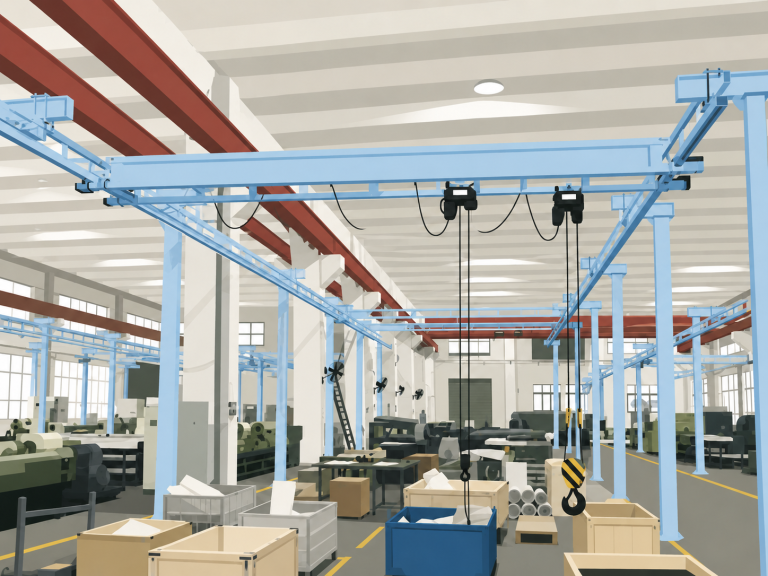
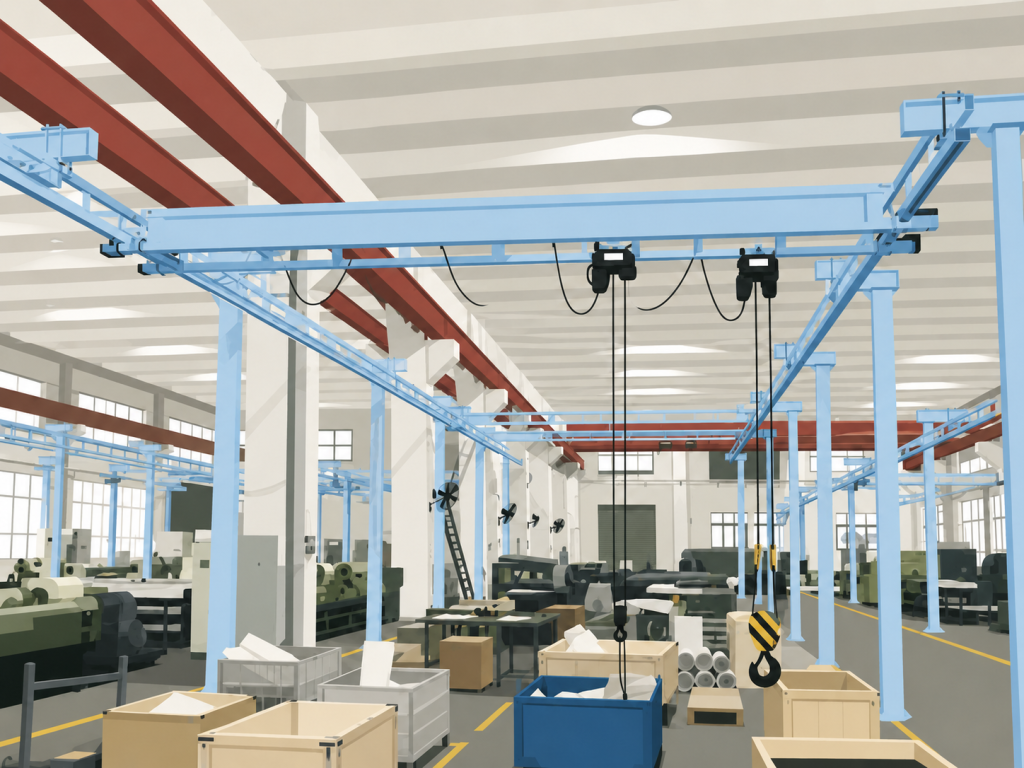
Industrial cranes often operate in tight, active work areas where controlled movement, repeatable positioning, and reliable distance feedback matter. Whether the application involves an overhead crane, jib crane, gantry crane, hoist, trolley, bridge, or moving crane structure, engineers may need a way to measure distance without mechanical contact.
A crane distance measurement ultrasonic sensor can be a practical option when the target is within range, has a usable reflective surface, and the sensor can be mounted with a clear acoustic path. For standard industrial sites, Migatron’s RPS-401A may be a fit for short-range analog distance measurement. For hazardous locations or explosive atmospheres, the RPS-429A-IS may be considered when the application requires an intrinsically safe ultrasonic sensor.
Quick Answer Box
| Question | Answer |
| What problem does this solve? | Non-contact distance feedback for crane components, moving structures, hoists, trolleys, bridge travel, or target positioning. |
| Best fit for ultrasonic sensing? | Short-range applications where the sensor has a clear view of a solid target surface. |
| Typical measurement needed | Distance, position feedback, travel limit reference, or object presence within approximately 4 to 216 inches for the primary recommended models. |
| Output type | Analog voltage or analog current, depending on the sensor model and control system. |
| Suggested Migatron sensor | RPS-401A for standard environments; RPS-429A-IS for hazardous locations requiring intrinsic safety. |
| When to contact engineering | When the crane operates in a hazardous area, the target surface is angled or irregular, the distance exceeds standard ranges or custom specs needed. |
Application Overview
Crane distance measurement is often needed when a moving crane component must be monitored relative to a fixed structure, stop point, load area, rail, wall, platform, or machine frame. In practical terms, the sensor may be used to monitor the position of a hoist, trolley, bridge, crane yoke, end stop, or moving crane structure.
Crane manufacturers and equipment builders, including companies that make overhead cranes, jib cranes, gantry cranes, wall console cranes, electric chain hoists, wire rope hoists, and hazardous location lifting equipment, may need compact non-contact sensors for distance feedback. The goal is not to replace the crane control system. The goal is to provide a usable analog distance signal that can be interpreted by a PLC, controller, display, or monitoring system.
Non-contact ultrasonic sensing may help because the sensor does not need to physically touch the moving crane component. That reduces mechanical wear and avoids adding limit arms, rollers, or contact switches in areas where contact is undesirable. This can be useful in industrial sites where cranes move repeatedly, where mechanical contact points wear over time, or where the target may be difficult to reach for routine maintenance.
How Ultrasonic Sensors Work in This Application
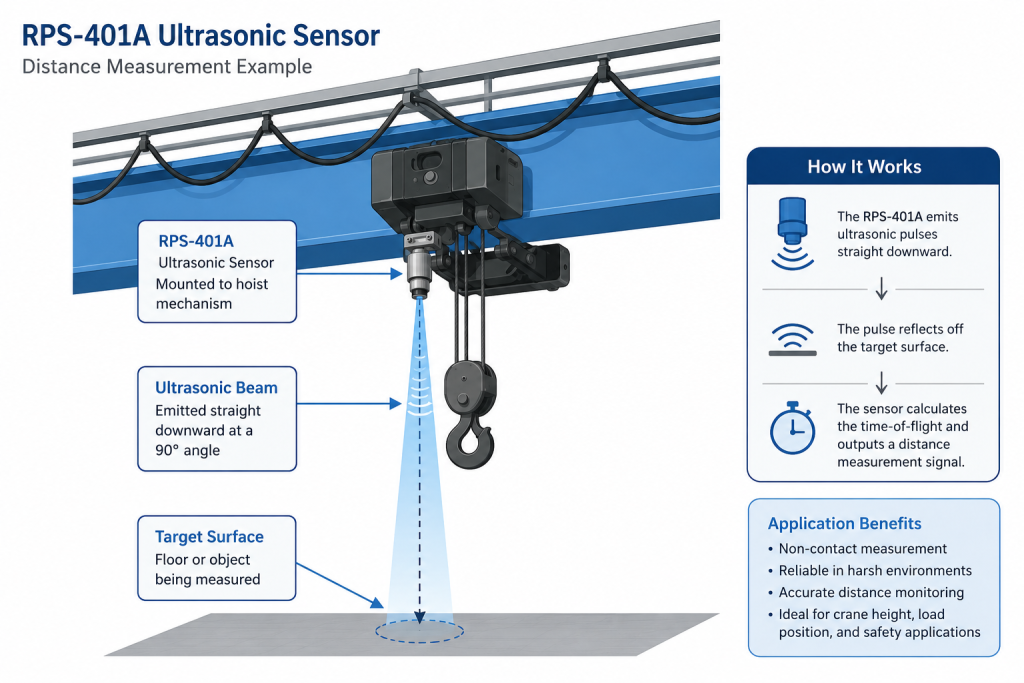
Ultrasonic analog sensors measure distance using time-of-flight. The sensor emits a high-frequency sound pulse toward a target. The sound reflects off the target and returns to the sensor. The sensor converts the time-of-flight into an analog output that changes with distance.
In a crane application, the target could be a steel plate, trolley structure, crane frame, hoist body, bracket, stop block, or another solid surface like the floor. For best results, the target should be large enough, stable enough, and positioned close to perpendicular to the sensor face. A flat target at a poor angle may deflect the sound away from the sensor, which can weaken the return signal.
Will Ultrasonic Work Here?
Ultrasonic sensing is usually a good fit when:
The sensing distance is within the selected sensor range.
The target has a solid surface that reflects sound back to the sensor.
The sensor can be mounted with a clear line of sight to the target.
The target movement is repeatable enough for the controller to interpret the analog signal.
Ultrasonic sensing may need review when:
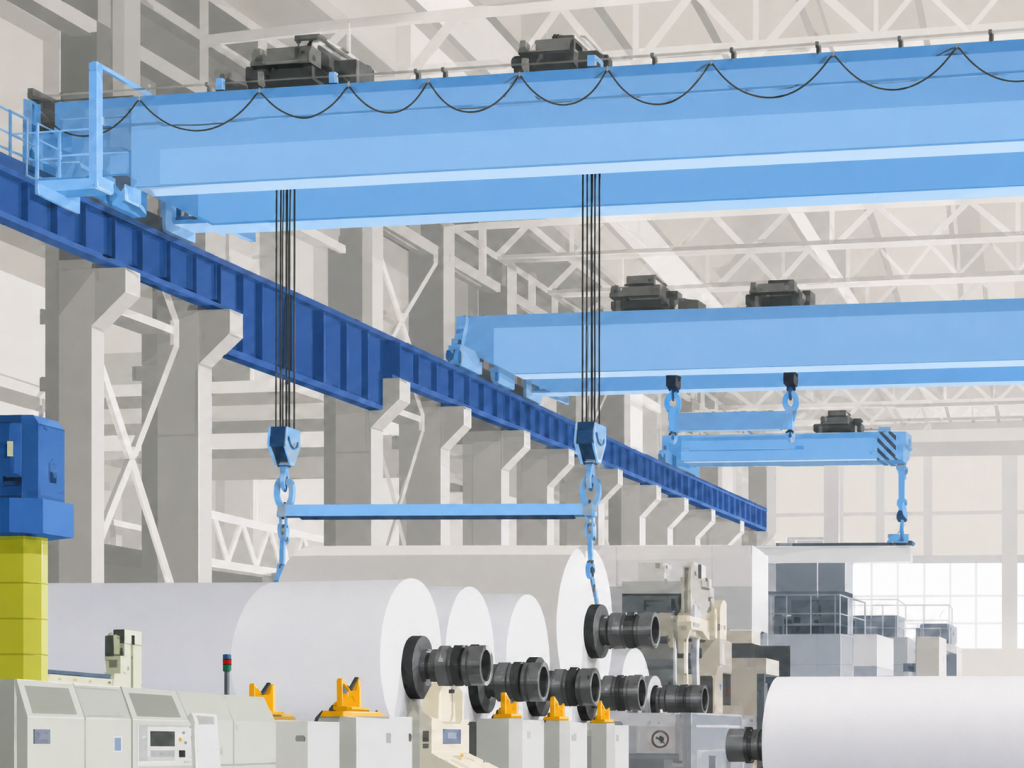
The sensing path may be blocked by hooks, cables, structural members or walkways
The required measurement distance exceeds the standard range of the recommended sensor.
Key Application Questions
| Question | Why It Matters |
| What crane component is being measured? | The target may be a trolley, hoist, bridge, yoke, stop plate, frame, or moving structure. |
| What is the minimum and maximum sensing distance? | The sensor must be selected so the target stays within the usable measurement range. |
| What is the target material? | Solid metal surfaces are often good reflectors, but surface shape and angle still matter. |
| Is the target flat, curved, angled, or irregular? | Ultrasonic sensors perform best when the reflected sound returns to the sensor face. |
| How fast does the target move? | Response time and signal interpretation must match the motion profile. |
| Is there a clear beam path? | Obstructions can create false echoes or block the target. |
| Where will the sensor be mounted? | Mounting affects angle, vibration exposure, cable routing, and maintenance access. |
| Is the area hazardous or classified? | Explosive atmospheres require the correct intrinsically safe sensor and approved installation method. |
| Are there temperature, dust, moisture, or chemical exposure concerns? | Environmental factors influence housing, cable, and approval requirements. |
Recommended Migatron Sensor Table
| Application Need | Measurement Type | Important Requirement | Suggested Migatron Sensor |
| Standard crane distance feedback | Analog distance measurement | 0-10 VDC or 4-20 mA output in a non-hazardous area | RPS-401A |
| Short-range trolley or hoist position feedback | Adjustable analog measurement window | Clear target and mounting within the 4-40 inch or 8-80 inch model range | RPS-401A |
| Standard industrial crane target distance | Non-contact distance monitoring | Narrow sensing beam and analog signal to PLC or controller | RPS-401A |
| Hazardous Location/Explosive Atmosphere crane equipment | Intrinsically safe distance measurement | Explosive atmosphere or classified area documentation required | RPS-429A-IS |
| Hazardous sites such as chemical plants, petrochemical plants, oil refineries, gas power plants, wastewater treatment plants, and paint shops | Analog current or voltage distance signal | Correct approval, barrier, wiring, and control drawing review | RPS-429A-IS |
| Crane application requiring custom specs | Customization dependent distance measurement | Range, target, and housing should be reviewed before recommendation | Contact Migatron Engineering |
Installation Considerations
| Factor | What to Check |
| Blind zone | Keep the target outside the sensor’s minimum sensing distance. |
| Sensor angle | Aim the sensor as close to perpendicular to the target surface as practical. |
| Beam path | Confirm the beam does not strike crane rails, guards, cables, hooks, brackets, or nearby structure. |
| Target surface | Use a stable, solid target surface with enough area to return a strong echo. |
| Environment | Review temperature, dust, moisture, washdown, chemical exposure, and air movement. |
| Mounting | Use a rigid mount that limits vibration and maintains alignment. |
| Cable and connector | Select cable length and connector style suitable for the crane structure and motion. |
| Output scaling | Confirm whether the controller expects increasing or decreasing output with distance. |
| Multiple sensors | Review sensor spacing and possible crosstalk if more than one ultrasonic sensor is used nearby. |
| Hazardous area requirements | Confirm area classification, approval requirements, safety barrier, grounding, and installation documentation. |
Example Application Scenario
An OEM building an industrial overhead crane needs distance feedback between a moving trolley assembly and a fixed reference point. The target is a flat metal plate mounted on the moving assembly, and the required measurement window is approximately 12 to 60 inches. The control system needs an analog signal to monitor the trolley’s position as it approaches a defined operating area.
For a standard industrial environment, Migatron may recommend the RPS-401A because it provides analog voltage and current outputs and can be adjusted over a defined measurement span within its range. If the same crane design is used in a petrochemical plant, paint shop, wastewater treatment plant, or other hazardous location, Migatron may recommend the RPS-429A-IS instead, provided the required sensing distance, output, approval, barrier, and installation details are compatible.
In both cases, the application should be reviewed before final sensor selection. The target angle, available mounting location, beam clearance, electrical interface, and environmental conditions determine whether ultrasonic sensing is practical.
Need help selecting an ultrasonic sensor for crane distance measurement? Contact Migatron with the sensing distance, target material, target shape, environment, mounting location, output requirement, and any hazardous-area approval requirements. Migatron can review the application and recommend whether the RPS-401A, RPS-429A-IS, or another ultrasonic sensor model is the better fit.
FAQ
Can ultrasonic sensors be used for crane distance measurement?
Yes, ultrasonic sensors can be used for crane distance measurement when the sensing distance, target surface, mounting angle, and environment are suitable. They are best used where a non-contact analog distance signal is needed and the target can reflect sound back to the sensor.
What crane components can be measured with an ultrasonic sensor?
Possible targets include a trolley, hoist body, bridge structure, crane yoke, stop plate, frame member, or fixed reference target. The best target is usually a solid, stable surface that stays within the sensor’s measurement range.
What output is typically used for crane distance feedback?
Analog outputs are common for distance feedback. The RPS-401A provides 0-10 VDC and 4-20 mA analog outputs for standard industrial applications. The RPS-429A-IS is available with 4-20 mA current loop or 1-5 V analog voltage versions for hazardous-location applications.
Can ultrasonic sensors be used on cranes in explosive atmospheres?
Yes, but only when the sensor, barrier, wiring, and installation method are appropriate for the hazardous area classification. For explosive atmospheres and hazardous locations, Migatron’s RPS-429A-IS may be reviewed as an intrinsically safe ultrasonic sensor option.
What sensing range should be considered?
For the primary recommended models, typical short-range crane applications are often reviewed within 4 to 80 inches, depending on the selected sensor. If the required distance is longer, or if the application approaches 216 inches, contact Migatron Engineering to review the target, output, and sensor family before specifying a model.
When should an engineer review the application?
Engineering review is recommended when the crane operates in a hazardous location, the target is angled or curved, the beam path is tight, multiple sensors are mounted near each other, the sensor is exposed to harsh environmental conditions, or the measurement is tied into a critical control function.