


Ultrasonic Sensors Help Automated Car Wash Systems Profile Vehicle Height and Maintain Equipment Clearance
Automated car washes must accommodate sedans, SUVs, pickup trucks, vans, rooflines, open truck beds, and other vehicle variations while moving equipment close enough to clean effectively without creating unnecessary contact or clearance problems. In a friction car wash, high-volume mini-tunnel car wash, or Drive-Thru Tunnel, repeated distance measurements can give the control system useful information about the vehicle moving through the wash.
An ultrasonic sensor mounted above the vehicle can measure the changing distance to its surface as it passes below. Those measurements can be used to build a simplified vehicle height profile that helps the controller position brushes, spray equipment, dryers, or other overhead mechanisms.
Quick Answer
| Question | Answer |
| What problem does this solve? | Measures changing distance to a moving vehicle so the control system can estimate vehicle height and maintain equipment clearance. |
| Best fit for ultrasonic sensing? | Non-contact profiling where the vehicle provides an acoustic target and the sensor can be protected from direct spray and excessive environmental interference. |
| Typical measurement needed | Approximately 4 to 144 inches, depending on sensor location and vehicle geometry. |
| Output type | 0 to 10 VDC analog voltage proportional to measured distance. |
| Suggested Migatron sensor | RPS-409A family, with the specific range selected for the installation geometry. |
| When to contact engineering | When conveyor speed, target angle, water or chemical exposure, multiple sensors, unusual vehicle geometry, or mounting constraints could affect performance. |
Application Overview: Vehicle Profiling in an Automated Car Wash
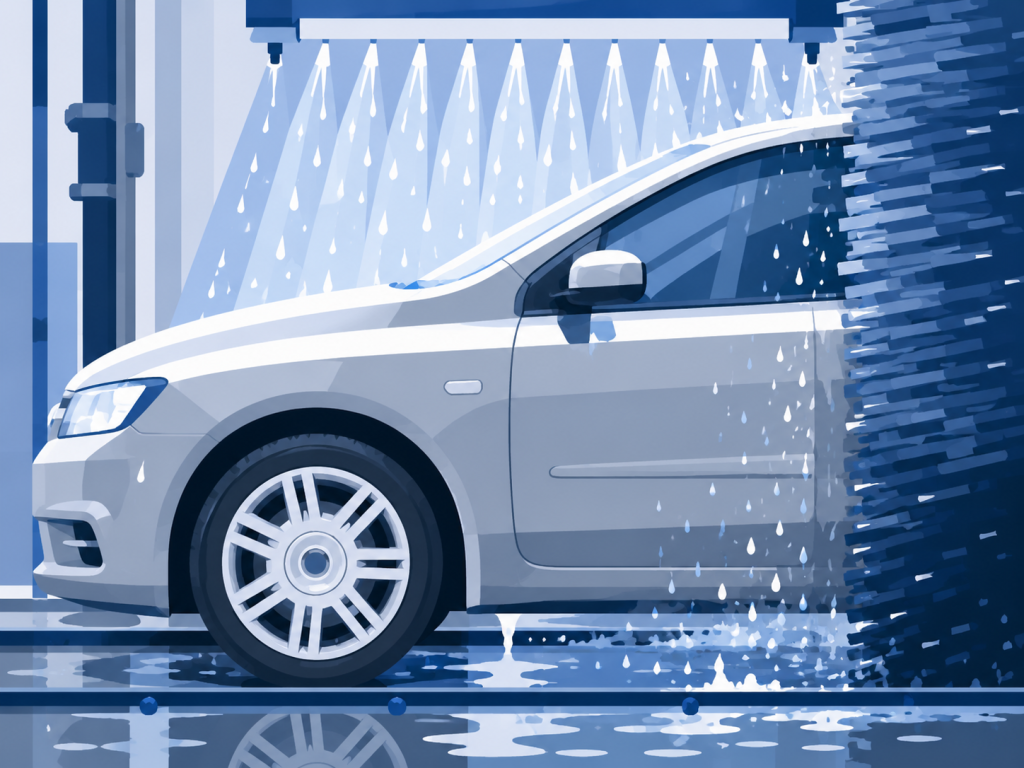
Vehicle profiling is different from simple vehicle presence detection. Instead of only asking whether a vehicle is present, the controller needs changing distance information as the vehicle progresses through the tunnel.
One practical configuration places an ultrasonic distance sensor above the conveyor near the tunnel entrance. The sensor measures downward toward the vehicle. Because the sensor mounting height is known, the controller can convert the measured sensor-to-vehicle distance into an approximate height relative to the conveyor floor.
As the vehicle moves forward, successive measurements can identify changes in its exterior profile, such as:
- Hood height
- Windshield and roof transition
- Maximum roof height
- Rear roofline
- Pickup truck bed
- End of vehicle
This type of information can help equipment manufacturers maintain clearance while still positioning wash components close enough to perform their intended function.
How Ultrasonic Sensors Work in This Application
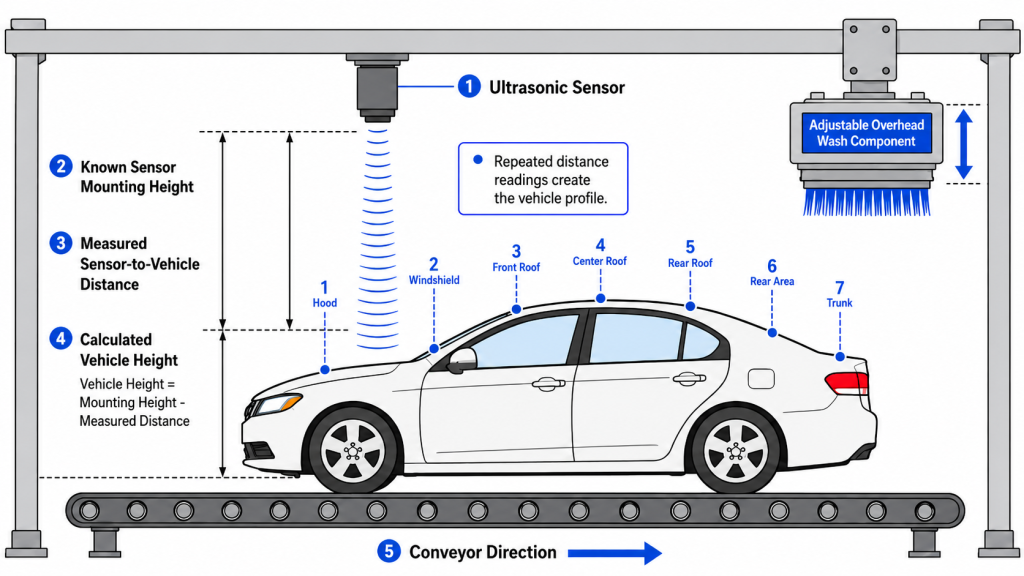
An ultrasonic sensor transmits sound pulses toward the vehicle and measures the time required for the reflected sound to return. That time-of-flight measurement corresponds to the distance between the sensor and the vehicle surface. Migatron analog ultrasonic sensors convert changing time of flight into a corresponding electrical output.
For example, the RPS-409A provides a 0 to 10 VDC analog output proportional to distance. The control system can read that signal through a PLC or other analog input and associate each measurement with the vehicle’s position along the conveyor.
The sensors operate from 20 to 30 VDC and include temperature compensation, PVC construction, a Sync/Tx input, and a 0 to 10 VDC analog output. Enclosure protection can be IP65 or IP67 depending on cable selection.
Importantly, 4 to 144 inches is the combined range of the product family, not the measurement range of oneRPS-409Amodel. The required sensor must be selected around the actual mounting distance.
Will Ultrasonic Work Here?
Ultrasonic sensing is usually a good fit when:
- The sensor has an unobstructed acoustic path to the vehicle.
- The vehicle remains within the selected sensor’s measurement range.
- The control system needs actual distance information rather than only presence detection.
Ultrasonic profiling is already used in car wash applications to identify vehicle contours and control equipment around features such as pickup beds and different vehicle heights.
Ultrasonic sensing may need review when:
- Heavy spray continuously crosses the acoustic beam.
- The target surface is steeply angled and reflects sound away from the sensor.
- Roof accessories or irregular shapes must be detected reliably.
Car washes are particularly challenging sensing environments because water, mist, steam, humidity, temperature changes, movement, and widely varying vehicle shapes can affect sensing systems. These conditions make application testing especially important.
Key Application Questions
| Question | Why It Matters |
| What is the minimum and maximum sensor-to-vehicle distance? | Determines whether the 40, 80, or 144 inch RPS-409A model is appropriate. |
| What vehicle surfaces will be measured? | Metal, glass, roofs, beds, and accessories may produce different echo characteristics. |
| How curved or angled are the surfaces? | Steep angles can direct the ultrasonic echo away from the sensor. |
| How fast is the conveyor moving? | Determines how many measurements can be collected along the vehicle. |
| Will spray, mist, steam, or chemicals cross the beam? | Environmental conditions can affect acoustic measurement reliability. |
| What signal does the controller require? | The standard RPS-409A provides 0 to 10 VDC. |
| Where can the sensor be mounted? | Mounting height and angle establish the usable measurement window. |
| Are hazardous area approvals required? | The standard RPS-409A is intended for non-hazardous installations. |
Installation Considerations
| Factor | What to Check |
| Blind zone | Keep all expected vehicle surfaces beyond the model’s minimum sensing distance. |
| Sensor angle | Aim toward surfaces likely to return the strongest usable echo. |
| Beam path | Keep rails, arches, hoses, brushes, and other hardware out of the sensing beam. |
| Target surface | Test sloped glass, curved body panels, pickup beds, and roof accessories. |
| Environment | Evaluate water spray, mist, chemicals, steam, humidity, and temperature changes. |
| Mounting | Provide a rigid mounting point that does not shift from vibration. |
| Cable/connector | Select the appropriate rated cable for the desired enclosure protection. |
Example Application Scenario
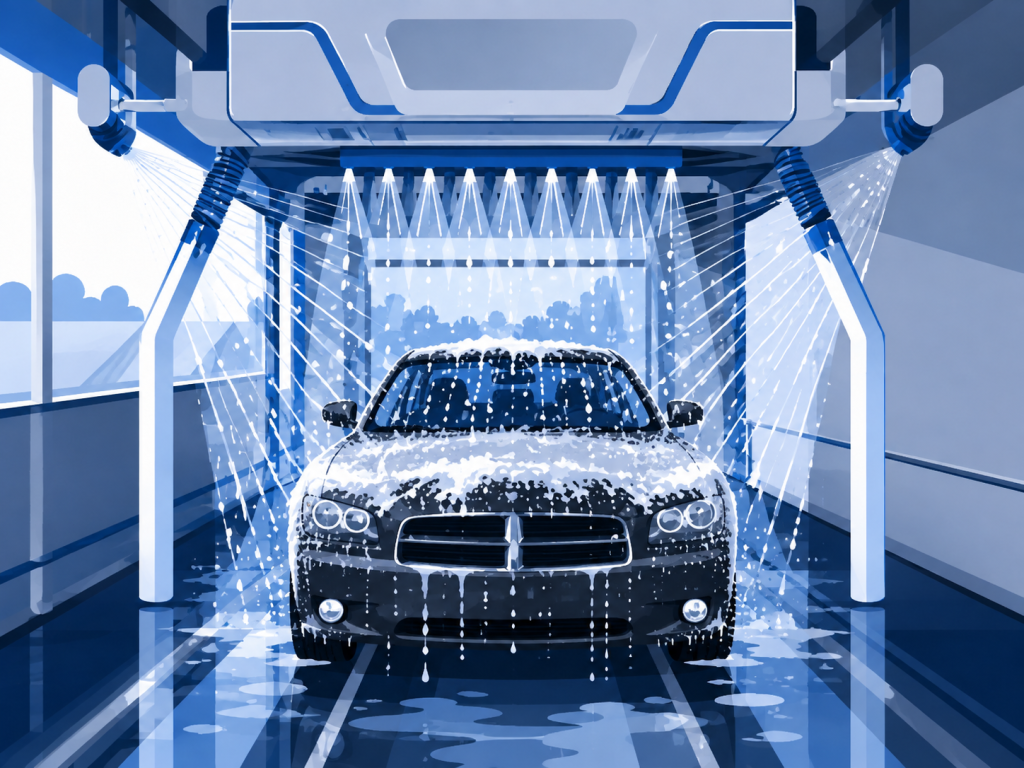
Consider a Drive-Thru Tunnel manufacturer installing an RPS-409A above the conveyor near the tunnel entrance.
When no vehicle is present, the controller knows the fixed distance between the sensor and conveyor surface. As a vehicle moves beneath the sensor, the analog signal changes continuously with the measured distance to the hood, windshield, roof, and rear surfaces.
The PLC combines those measurements with conveyor movement to create a simplified longitudinal profile.
That profile could then be used by downstream equipment to establish clearance limits. A top brush might rise for a taller SUV, a spray arch could alter operation according to vehicle height, or equipment could react differently when the controller recognizes the height transition associated with an open pickup bed.
Discuss Your Car Wash Application With Migatron
Are you developing a vehicle profiling, equipment-clearance, or other continuous distance measurement system for an automated car wash?
Send Migatron your specs. Migatron engineering can review the application and determine whether an RPS-409A Ultrasonic Sensor configuration is appropriate before the sensor is integrated into the equipment.
Frequently Asked Questions
Can an ultrasonic sensor measure vehicle height in a car wash?
Yes. If the sensor is installed at a known height, its distance measurement can be used to calculate the approximate height of the vehicle surface below it. Repeated readings can form a simplified vehicle profile.
Can ultrasonic sensors detect an open pickup truck bed?
Potentially. Sonar profiling systems are used in car washes to identify the transition between the cab and open bed so downstream equipment can respond appropriately. Detection reliability depends on sensor position, geometry, speed, and control logic.
Which RPS-409A model should be used?
The model should be selected according to the actual sensor-to-vehicle distance. The RPS-409A-40 covers 4 to 40 inches, the RPS-409A-80 covers 6 to 80 inches, and the RPS-409A-144 covers 10 to 144 inches.
Can multiple ultrasonic sensors be used together?
Yes. The RPS-409A includes a Sync/Tx line that can be used to synchronize multiple sensors and help prevent ultrasonic crosstalk.
Will water or mist interfere with ultrasonic measurement?
They can. Car washes contain spray, mist, steam, humidity, temperature changes, and moving equipment, so the installation should be evaluated under actual operating conditions rather than assuming laboratory performance will translate directly into the tunnel.
Can vehicle profiling help reduce water and chemical consumption?
Potentially. Knowing where the vehicle is and how its profile changes gives the controller information it can use to operate wash components only where needed. Industry sources identify vehicle profiling as one method for reducing unnecessary water and chemical use.