

Opening Summary
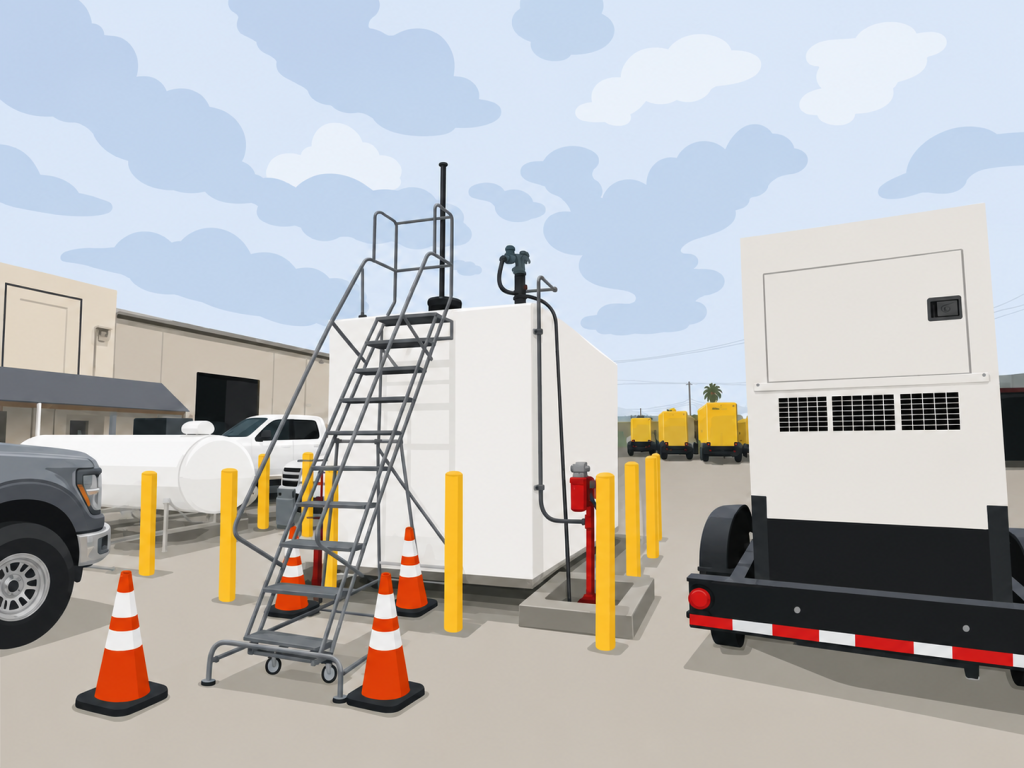
Industrial pump packages often depend on onboard diesel fuel tanks or external fuel storage to keep engines operating for extended periods without interruption. Without continuous fuel level information, operators may have to rely on manual inspections, mechanical gauges, or estimated fuel consumption. An inaccurate estimate can result in an unexpected shutdown when the tank runs empty.
A non-contact ultrasonic fuel level sensor provides another approach. Mounted above the diesel fuel surface, the sensor measures the distance between its sensing face and the fuel without requiring the sensing element to contact the liquid. That measurement can be transmitted to a PLC or remote monitoring system for continuous fuel level monitoring.
Where fuel vapors or other conditions create a classified hazardous location, an intrinsically safe level sensor may also be required.
Quick Answer
| Question | Answer |
| What problem does this solve? | Continuous monitoring of diesel fuel level to track consumption, generate low-level alarms, and reduce unexpected pump shutdowns. |
| Best fit for ultrasonic sensing? | Tanks with a clear acoustic path from the sensor to the fuel surface and sufficient space above the maximum fuel level. |
| Typical measurement needed | Approximately 4-40 in. for many onboard tanks, with 6–80 in. available for deeper tanks. |
| Output type | 4-20 mA analog current loop. |
| Suggested Migatron sensor | RPS-429A-IS Intrinsically Safe Ultrasonic Sensor. |
| When to contact engineering | When the tank contains baffles, fill tubes, pickup tubes, unusual geometry, heavy vapor conditions, limited mounting space, or specific hazardous area requirements. |
Application Overview
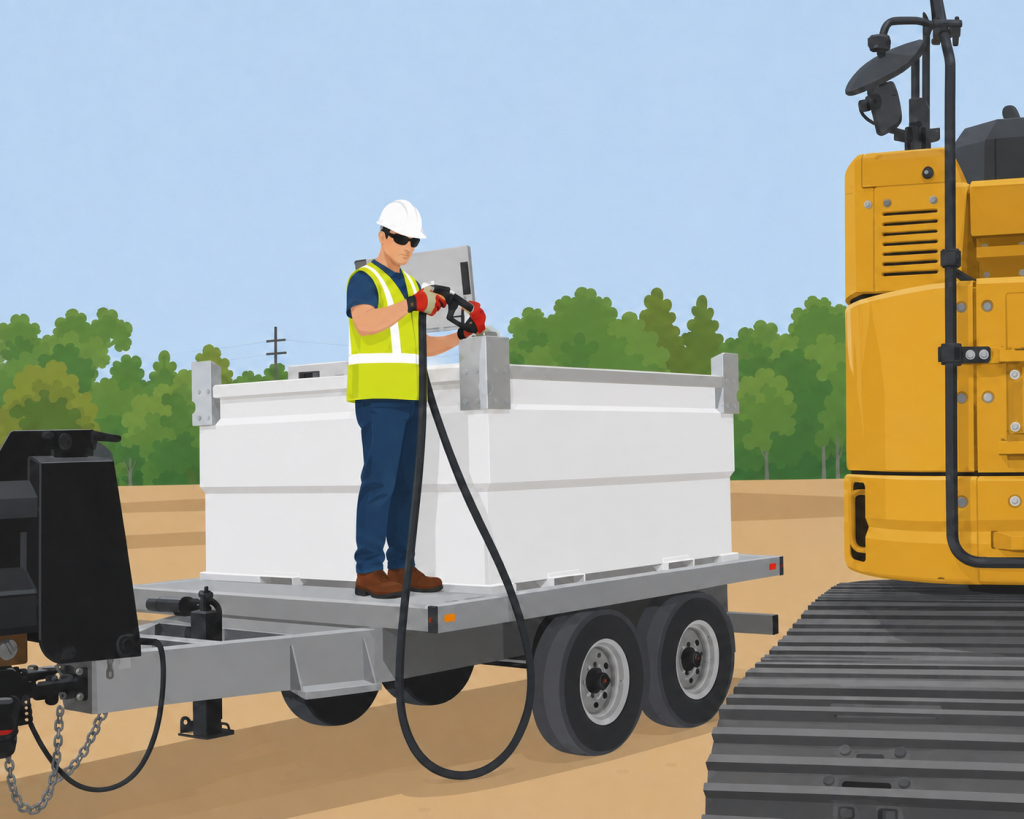
A diesel powered industrial pump may operate for hours or days between refueling. Knowing how much fuel remains can therefore become an important part of equipment monitoring.
An ultrasonic fuel level sensor can be installed at the top of the tank and aimed downward toward the diesel surface. Because the measurement is non-contact, the sensing face does not need to be submerged in the fuel.
The resulting distance measurement can be converted by the equipment controller into fuel level, remaining fuel volume, or percentage full. The controller can then use this information to:
- Display fuel level locally or remotely
- Track fuel consumption
- Alert operators before the pump shuts down from lack of fuel
Actual performance depends on tank dimensions, sensor mounting location, the distance to the liquid, internal tank structures, environmental conditions, and the required hazardous area classification.
How Ultrasonic Sensors Work in This Application
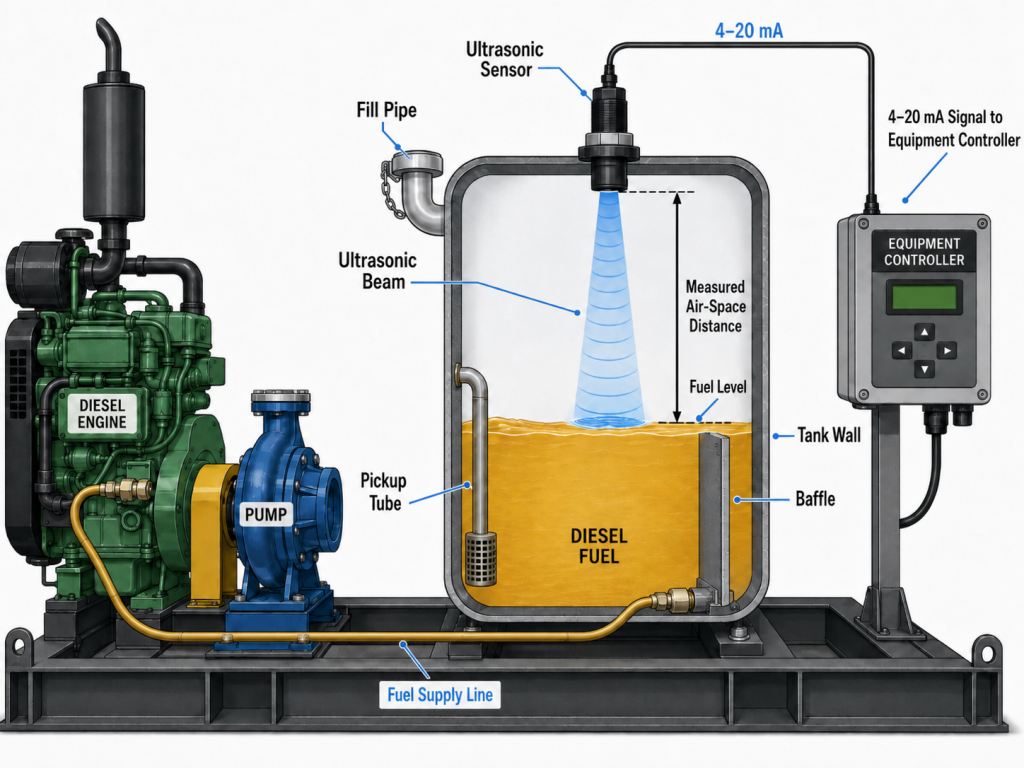
Ultrasonic sensors measure distance using time-of-flight.
The sensor transmits an ultrasonic pulse toward the diesel fuel surface. The sound reflects from the liquid and returns to the sensor. The sensor measures the elapsed time and converts it into distance.
For tank monitoring, the controller can use the measured air space distance to determine fuel level.
For example, if the distance from the sensor face to the bottom of a tank is known, the system can calculate:
Fuel level = Tank reference distance − Measured air space distance
The RPS-429A-IS provides a proportional 4–20 mA current output, allowing the measurement to be incorporated into common industrial control and monitoring systems.
Will Ultrasonic Work Here?
Ultrasonic sensing is usually a good fit when:
- The fuel surface remains within the sensor’s specified measurement range.
- There is a clear path between the sensor and fuel.
- The installation provides adequate distance above the maximum fuel level.
Ultrasonic sensing may need review when:
- Fill pipes or fuel pickup tubes are close to the sensor.
- The tank has very limited headspace.
- Fuel movement or sloshing is severe.
Migatron engineering should review applications where these conditions could affect measurement reliability.
Key Application Questions
| Question | Why It Matters |
| What is the minimum and maximum sensor-to-fuel distance? | Determines the required sensing range and whether the fuel enters the sensor’s blind zone. |
| What liquid is being measured? | Confirms target characteristics and environmental compatibility. |
| Is the fuel surface normally flat or moving? | Sloshing and turbulence can affect echo stability. This may require a standpipe for a clear reading. |
| How much does fuel movement occur during pump operation? | Helps determine whether signal filtering or averaging may be useful. |
| What temperatures and outdoor conditions will the sensor experience? | Influences sensor and installation requirements. |
| Where can the sensor be mounted? | Mounting location determines beam clearance and measurement geometry. |
| What hazardous area approvals are required? | The sensor, barrier, wiring, and installation must meet the applicable requirements. |
Recommended Migatron Sensor
| Application Need | Measurement Type | Important Requirement | Suggested Migatron Sensor |
| Typical onboard diesel tank | Continuous non-contact level | Approximately 4-40 in. measurement range | RPS-429AA-40P-IS |
| Deeper external or equipment tank | Continuous non-contact level | Approximately 6-80 in. measurement range | RPS-429AA-80P-IS |
| PLC or equipment controller integration | Analog level measurement | 4–20 mA current loop | RPS-429A-IS family |
| Hazardous Location | Continuous level measurement | Appropriate intrinsic safety approval and installation | RPS-429A-IS, subject to application review |
The exact model and approval configuration should be selected after reviewing tank geometry, sensing distance, hazardous area classification, and installation requirements.
Installation Considerations
| Factor | What to Check |
| Blind zone | Ensure the highest possible fuel level remains beyond the sensor’s minimum sensing distance. |
| Sensor angle | Mount the sensor so its sensing face is approximately parallel with the fuel surface. |
| Beam path | Keep fill pipes, baffles, pickup tubes, tank walls, brackets, and other structures out of the sensing field. |
| Target surface | Consider sloshing, turbulence, foam, or other conditions that may produce inconsistent echoes. |
| Environment | Evaluate moisture, dust, temperature, vibration, condensation, and outdoor exposure. |
| Mounting | Use a rigid mounting point that maintains sensor position during equipment operation. |
| Cable and connector | Select cabling and connections appropriate for the enclosure and hazardous-area installation. |
| Hazardous area | Verify sensor approval, intrinsic safety barrier, entity parameters, wiring practices, and applicable electrical codes. |
Example Application Scenario

An OEM is designing a diesel powered pump package with an onboard fuel tank approximately 32 inches deep. Operators need continuous fuel information because the pump may run unattended for extended periods.
An RPS-429AA-40P-IS2 ultrasonic tank level sensor is mounted at the top of the tank and aimed vertically toward the diesel surface. Its mounting location is selected so the ultrasonic beam does not intersect the fill pipe, fuel pickup tube, tank wall, or internal baffle.
The sensor’s 4-20 mA output connects through the required intrinsically safe installation to the pump controller. The controller scales the signal to represent tank level and calculates an approximate percentage of fuel remaining.
As fuel is consumed, the measured distance increases. When the calculated level reaches the OEM’s programmed low fuel threshold, the controller generates a warning for the operator or remote monitoring system.
This allows fuel status to become part of the pump’s normal control system instead of relying exclusively on manual inspection.
Discuss Your Fuel Tank Level Application With Migatron
Contact Migatron Corporation to review your diesel fuel tank level monitoring application and determine whether the RPS-429A-IS or another intrinsically safe ultrasonic sensor configuration is appropriate.
Frequently Asked Questions
Can an ultrasonic sensor measure diesel fuel without touching it?
Yes. An ultrasonic sensor can be mounted above the liquid and measure the distance to the diesel surface using reflected sound. The sensing element does not need to be submerged in the fuel.
Can a 4–20 mA signal be used to monitor diesel fuel level?
Yes. The proportional output from the sensor can be read by a compatible PLC, controller, panel meter, or remote monitoring system and scaled to represent fuel level, volume, or percentage full.
Which sensing range should be used for a diesel tank?
The range depends on the minimum and maximum distance between the sensor face and fuel surface. The RPS-429A-IS family includes 4–40 in. and 6–80 in. sensing ranges. Tank dimensions should be reviewed before selecting a model.
Can an ultrasonic sensor work inside a tank with baffles?
Potentially, but the installation requires careful review. A baffle inside the ultrasonic beam can produce an unwanted echo. The preferred mounting position provides an unobstructed acoustic path to the fuel. You may consider using a standpipe in your installation.
Does fuel sloshing affect ultrasonic level measurement?
Significant movement can cause the measured distance to fluctuate because the sensor is seeing a moving surface. Controller averaging, filtering, mounting location, and the required measurement response should be considered for mobile or high-vibration equipment.
Can the sensor be used in a hazardous location?
The RPS-429A-IS family is designed for intrinsically safe applications and is available with hazardous area approvals. The required sensor configuration, intrinsic safety barrier, cabling, entity parameters, and installation method must match the specific classification and applicable requirements.