
Getting Reliable Performance from Ultrasonic Sensors
Ultrasonic sensors are widely used for tank level measurement because they provide non-contact, continuous monitoring without being affected by the physical properties of the liquid. But performance is not just about choosing the right sensor. Installation and application details play a critical role.
Engineers who account for these factors early avoid false readings, dead zones, and inconsistent outputs. The following design considerations will help ensure accurate, repeatable measurements in real-world tank applications.
Mounting Location
In most tank level applications, the sensor is mounted at the top of the tank and aimed directly at the liquid surface. This straight, perpendicular path provides the strongest and most reliable echo signal.
Problems start when that path is disrupted. Internal structures such as ladders, mixers, fill pipes, or agitators can reflect or scatter the ultrasonic signal. These obstructions can create false targets or reduce signal strength.
Whenever possible, mount the sensor in a clear, unobstructed location. If that’s not feasible, consider repositioning the sensor or using a narrower beam angle to isolate the target surface.
Dead Zone
Every ultrasonic sensor has a minimum sensing distance, often referred to as the dead zone. Within this region, the sensor cannot reliably detect a target because the transmitted signal has not fully dissipated.
Ignoring the dead zone leads to one of the most common issues in tank level measurement. As the tank fills, the level enters this unusable range, and the sensor either loses the signal or produces unstable readings.
When selecting a sensor, make sure the usable range aligns with your tank geometry. The maximum fill level should always remain outside the dead zone to maintain continuous measurement.
Surface Conditions
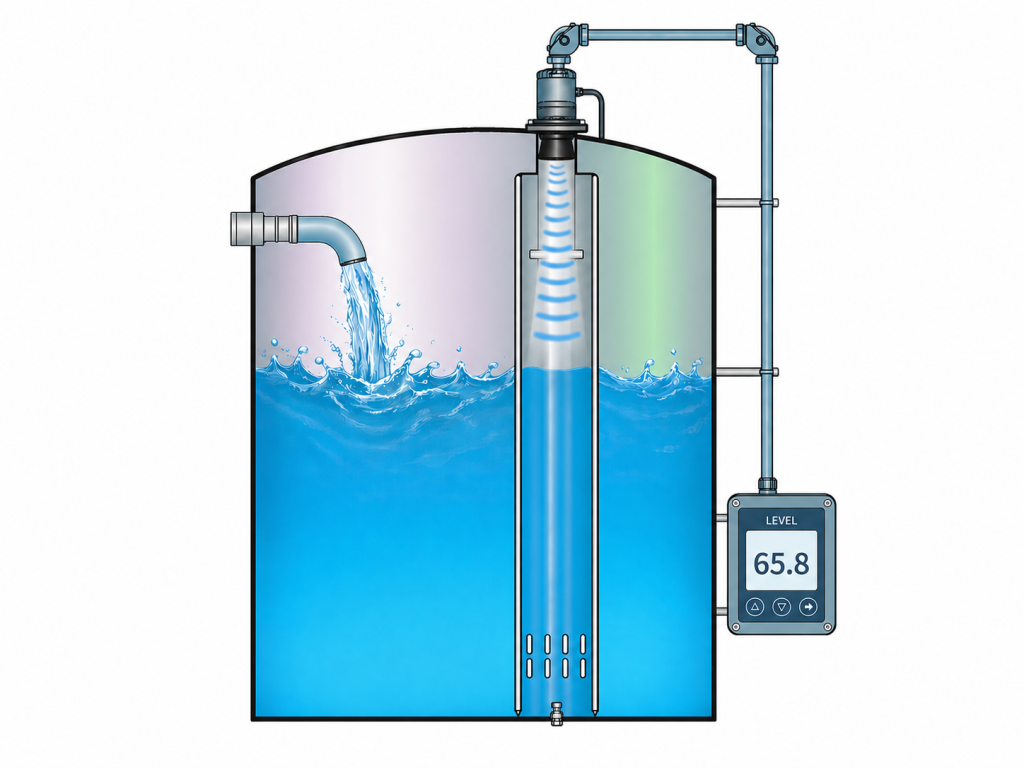
Stable, flat surfaces provide the strongest and most consistent signal return. In real-world applications, however, conditions are often less predictable. Foam, heavy vapors, turbulence, or splashing can absorb or scatter the ultrasonic signal, leading to weak or unstable readings.
In these situations, both sensor selection and installation strategy become critical. Adjusting the mounting position or distance from agitation can help improve signal reliability.
For more challenging applications, a standpipe is often used to stabilize the measurement. By isolating a small section of the liquid from the main tank, the standpipe creates a calmer surface for the sensor to read. This approach is especially effective in tanks with constant mixing, filling, or surface disturbance.
Understanding how surface conditions affect signal return allows for better system design and more consistent level measurement.
Output Requirements
Sensor output type should match the control system requirements from the start.
For most industrial applications, 4–20 mA is the standard. It provides noise immunity over long cable runs and integrates easily into control systems. Many ultrasonic sensors, including intrinsically safe models, offer 4–20 mA outputs for direct loop control and monitoring.
Voltage outputs, such as 0–10 V or 1–5 V, are often used for shorter distances or direct PLC analog input cards. These outputs can simplify integration but are more susceptible to electrical noise.
Choosing the wrong output type can complicate installation or reduce signal reliability, so it should be defined early in the design phase.
Environmental Factors
Tank environments are rarely controlled. Temperature swings, humidity, and exposure to chemicals or vapors all impact long-term sensor performance.
Temperature affects the speed of sound, which directly influences ultrasonic measurement. Many sensors include built-in temperature compensation to maintain accuracy across varying conditions .
Housing material is another key consideration. Standard PVC housings work well in many environments, but chemical exposure may require alternatives like PTFE or other custom solutions.
In hazardous locations, intrinsic safety becomes critical. Intrinsically safe systems limit electrical energy so that ignition cannot occur, even in the presence of flammable gases . This allows safe operation in environments where traditional electrical equipment would pose a risk.
Bringing It All Together
Reliable tank level measurement is not achieved by sensor selection alone. It is the result of aligning the sensor, installation, environment, and control system requirements.
When mounting is optimized, the dead zone is accounted for, surface conditions are understood, and outputs are properly integrated, ultrasonic sensors deliver consistent, accurate performance across a wide range of applications.
For engineers and OEMs, these design decisions are what separate a working system from a dependable one.
Contact Us
Need help selecting the right ultrasonic sensor for your tank level application?
Provide your tank size, liquid type, and environment details, and we will recommend a sensor configuration that fits your system.