
When specifying an ultrasonic sensor for OEM equipment, engineers typically focus on sensing range, output type, and environmental ratings.
But one design factor has a direct impact on measurement stability and long-term performance:
Ultrasonic sensor beam angle and target alignment.
Ignoring beam geometry during mechanical design can result in unstable readings, reduced effective range, and unnecessary troubleshooting during setup.
If you are integrating ultrasonic sensors into tank systems, conveyor assemblies, or automated equipment, target angle should be part of the design phase.
How Ultrasonic Sensor Beam Angle Affects Measurement Accuracy
Ultrasonic sensors operate by emitting a high-frequency sound pulse and measuring the time-of-flight of the returning echo.
Ultrasonic energy propagates in a cone-shaped beam. The beam diameter increases with distance from the sensor face.
Models such as the Migatron RPS-400-30 are engineered with a narrow sensing beam to improve precision and reduce unwanted reflections . Narrow beams are ideal for confined OEM designs, but they require proper mechanical alignment to maintain consistent echo return.
For analog ranging sensors like the RPS-409A series and the intrinsically safe RPS-429A-IS series, stable echo return directly determines output linearity and repeatability .
Ultrasonic Sensor Target Angle: Why 90 Degrees Matters
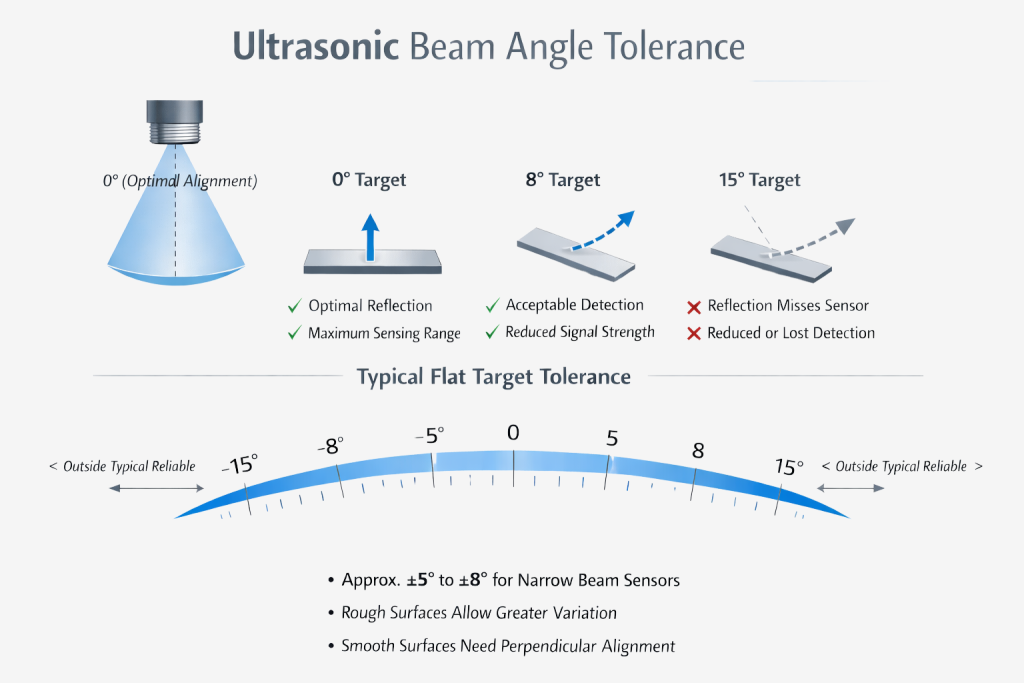
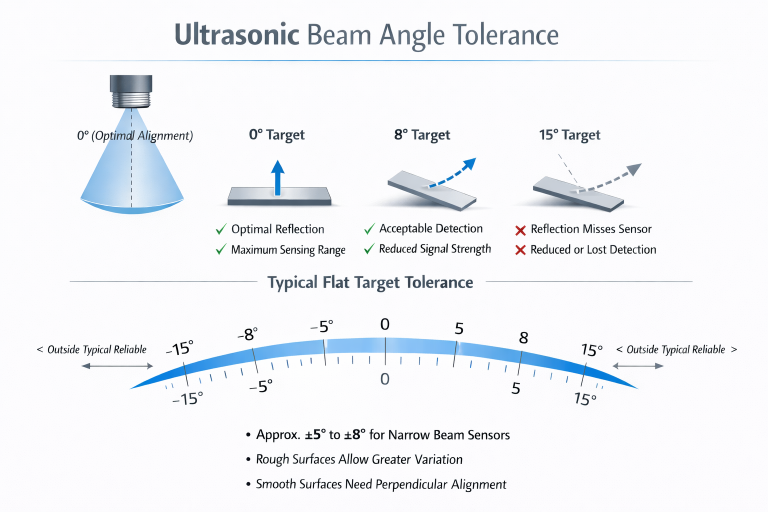
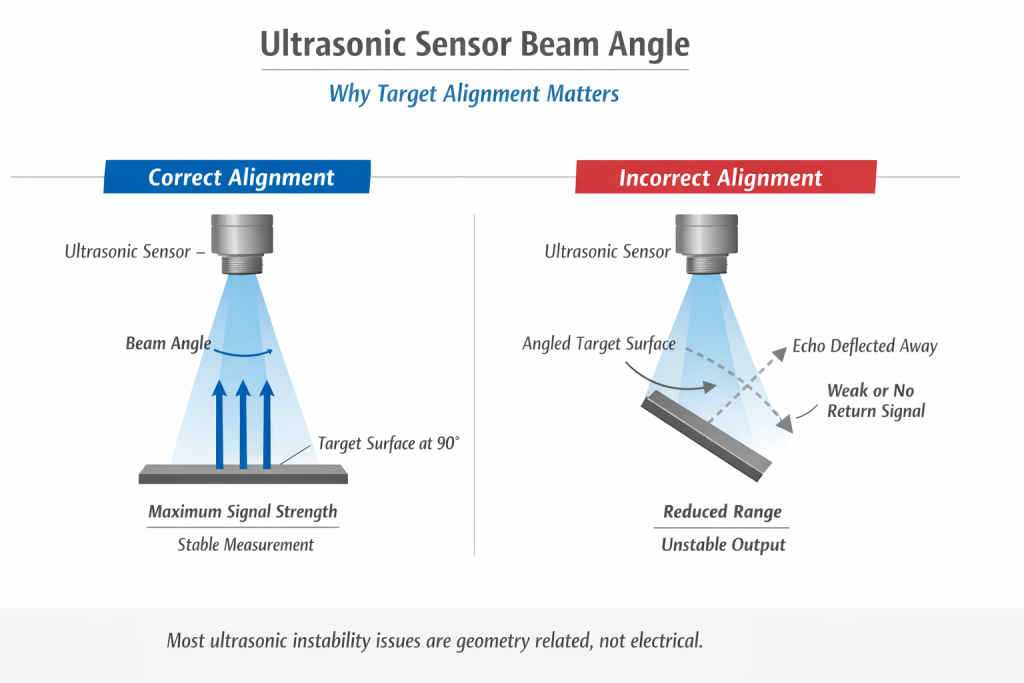
Maximum sensing range and signal strength occur when the target surface is perpendicular to the sensor face.
If the surface is angled too much, reflected sound energy deflects away from the transducer instead of returning to it. The result can include:
- Reduced signal amplitude
- Fluctuating analog output
- Shortened sensing range
- Intermittent detection
- Sensor cannot see the target
Smooth surfaces are more sensitive to angular misalignment because they reflect sound directionally. Rough surfaces scatter sound more diffusely and can tolerate greater angular deviation.
In OEM applications where parts may tilt or liquid surfaces are unstable, this behavior must be accounted for in the design phase.
Sidebar: Intrinsically Safe Ultrasonic Sensor for Hazardous Tank Level Measurement
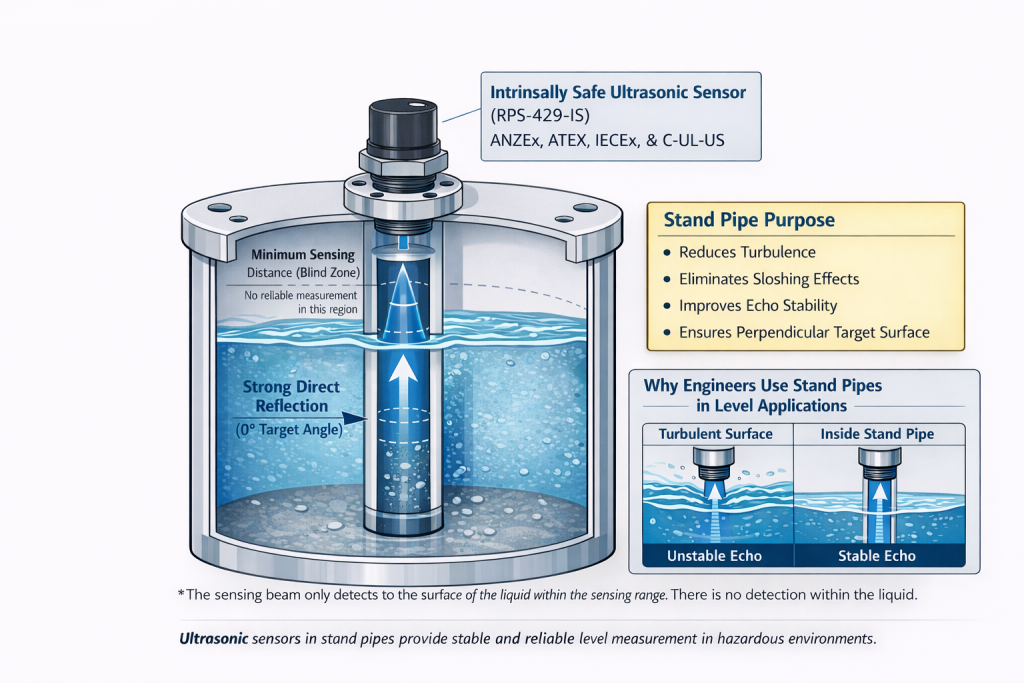
For hazardous tank level applications, beam alignment is just as critical as electrical compliance.
The Migatron RPS-429A-IS is an intrinsically safe ultrasonic sensor for hazardous locations when used with an approved safety barrier.
In tank level applications, this means:
- Mounting should maintain perpendicular alignment to the liquid surface.
- Sloped tank roofs or internal structures must not deflect the echo path.
- Stand pipes may be required in turbulent conditions.
Stable hazardous area measurement depends on correct beam orientation.
Ultrasonic Sensor Alignment Best Practices for OEM Equipment
To prevent performance issues after deployment:
- Design sensor mounts that maintain perpendicular alignment to the target surface.
- Evaluate the worst case target angle if product orientation varies.
- Avoid over specifying range. Shorter range sensors often provide tighter beam control.
- Validate beam clearance inside tanks, chutes, and enclosures.
- Confirm mechanical tolerances before production release.
Ultrasonic measurement is extremely reliable when geometry is correct.
Final Takeaway for Engineers Specifying Ultrasonic Sensors
If you are designing new OEM equipment and specifying ultrasonic sensors, treat beam angle and target alignment as primary design parameters, not afterthoughts.
Most instability issues are mechanical, not electrical.
Solve beam geometry early, and your ultrasonic system will perform consistently day in and day out.
For design consultation, Contact Us and our Engineering Department will be happy to assist you.