
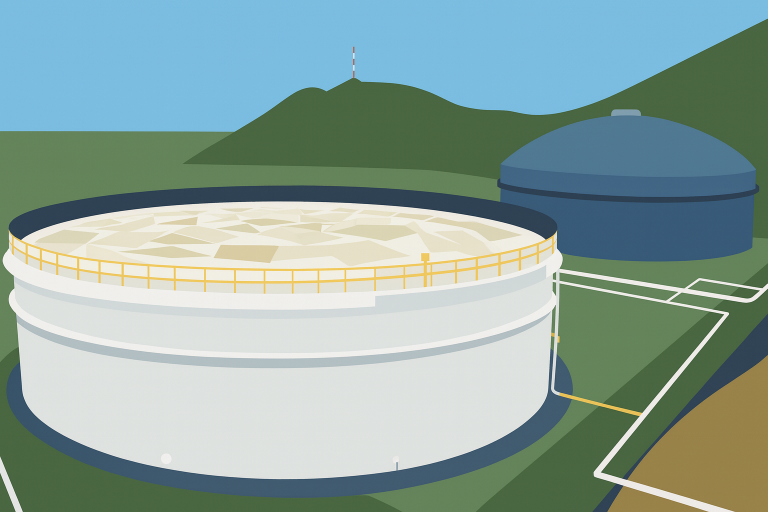
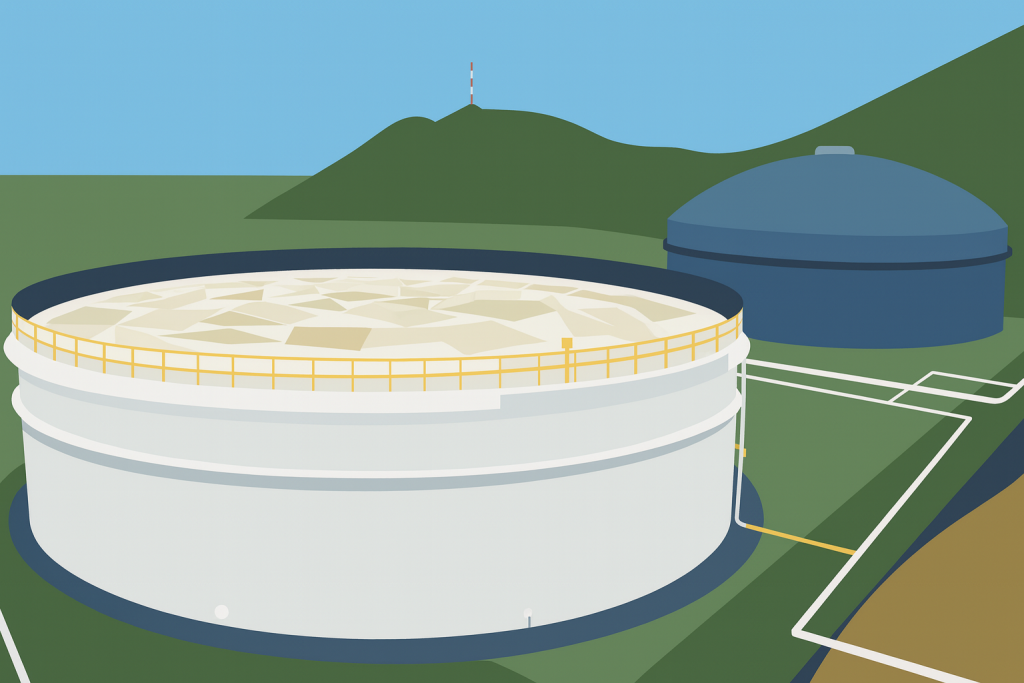
Floating roof tanks are a different problem entirely when compared to fixed or dome roof designs. In these tanks, the very feature that minimizes vapor space and reduces emissions, the floating roof, removes the air gap required for ultrasonic level measurement. Without a consistent headspace above the liquid, there’s no reliable acoustic path to the liquid surface. From a measurement physics standpoint, that makes direct ultrasonic level monitoring impractical.
But that doesn’t mean ultrasonics have no place in floating roof environments. The key is understanding what can actually be measured. When the roof is in contact with the liquid, you’re dealing with a moving mechanical structure, not an exposed fluid surface. This shifts the engineering focus from tracking liquid level to tracking roof position, roof movement, and roof integrity. Those are areas where ultrasonics excel.
In real field conditions, floating roof problems tend to show up in the same ways: uneven lift, sticking on support legs, misalignment as the roof travels, or sagging that creates uneven gaps around the perimeter. These mechanical behaviors are detectable with short-range ultrasonic sensors. Engineers use ultrasonic distance readings to confirm that the roof is lifting uniformly, verify that support legs are extended or retracted properly, or monitor the gap between the roof and the shell during transitions. These are important checks because mechanical issues in floating roof tanks often become safety issues if they go unnoticed.
Because the measurement is no longer about long range echo profiling and instead about precise positional detection, we typically specify the RPS-409A-IS3 Intrinsically Safe Ultrasonic Sensor for these tasks. It’s a short range ultrasonic sensor with fast response and stable near-field performance, which is exactly what floating roof monitoring requires. You’re measuring short range distances, often in conditions with variable lighting, heavy vapors, or obstructed sight-lines. Ultrasonics give you reliable position feedback without relying on visual systems or contact based mechanisms that wear out or foul in hydrocarbon environments.
The practical field approach is simple: identify the mechanical points on the roof where failure or misalignment is most likely to occur, mount the ultrasonic sensors so they track those distances continuously, and feed the output into your PLC for alarm or trend monitoring. The sensor becomes the early warning device that tells operators when something isn’t moving the way it should. It’s not about fluid measurement; it’s about structural awareness.
Floating roof tanks aren’t where ultrasonics measure level. They’re where ultrasonics protect assets. When engineers apply them for what they’re good at, short range positional monitoring, they provide a layer of visibility that mechanical switches and visual checks can’t match. And in tanks storing gasoline, petrochemicals or crude, early detection of roof irregularities is far more valuable than a secondary level reading ever would be.